50 |
Oilfield Technology
September 2016
C. Poly acrylic acid co-2 acryamido-2-methylpropan sulfonic acid
co-sulfonated styrene (8000 to 12 000 Da).
O
NH
O
SO
3
H
OH
*
S
OH O
O
n
*
l
m
is generally known that the presence of metal ions such as Ca, Mg, Al, Fe, Cu, etc. affect the rate of
recipitation and crystal morphology of scale forming salts. These metal ions are known to form
soluble salts with silicate ions. The precipitation of metal-silicate salts is known to strongly impact the
recipitation conditions. Furthermore, the change in physical conditions, such as temperature and pH,
an affect calcium carbonate and calcium sulfate scales, for example, which is contrary to that of silica
cale because these behave inversely. Higher temperatures can affect the solubility product of calcium
arbonate scales in the opposite direction and are less soluble in high-temperature water compared to
wer temperature. All the above elaborated facts help us arrive at one conclusion: a field-custom-
esigned chemical development is key in developing the right chemical formulation.
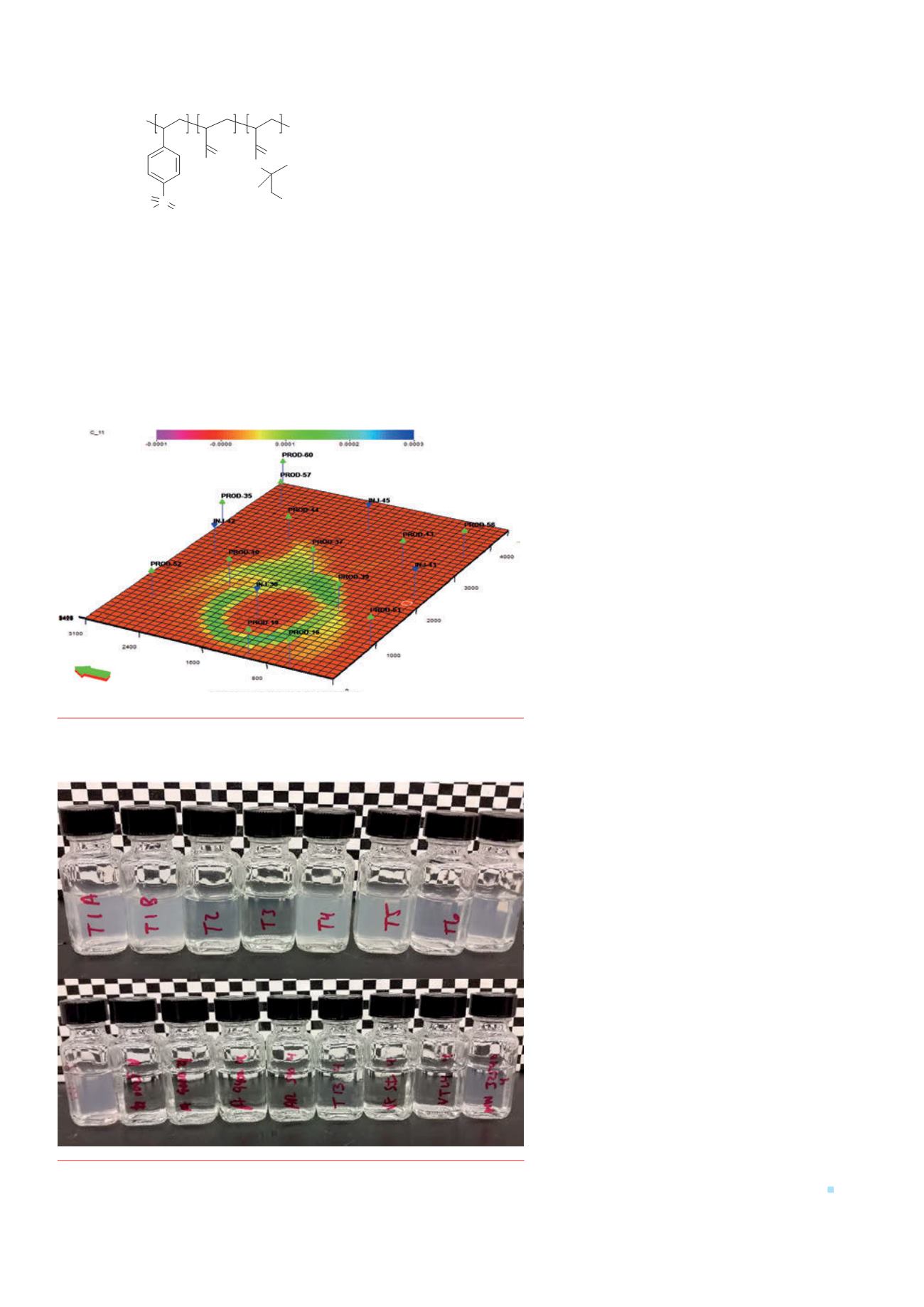
igure 4: Existing silica scale dispersants (left) vs. new synergistic silica control blends (right).
igure 4 illustrates the direct comparison of silica dispersant chemistry performance. The performance
f the pure product is indicated on the left hand picture. A clear solution shows optimum performance
nd keeps the silica scale homogenously dispersed; haze is a sign of a failure as it is caused by silica
cale precipitation. Silica polymerisation experiments were performed with supersaturated solutions of
0 mL magnesium brine added to 50 mL silica brine in a polyethylene container at room temperature
nd adjusted pH. The solution was allowed to react for 22 hours and pictures were taken. The different
hibitor products were added and the solution was allowed to react another 22 hours before the final
ictures were taken. The same base chemistries were tested on the right hand side in form of
It is generally known that the pr nce of metal i ns, such
as Ca, Mg, Al, Fe, Cu, etc., affects the rate of precipitation
and crystal morphology of scale forming salts. These metal
ions are known to form insoluble salts with silicate ions.
The precipitation of metal-silicate salts is known to strongly
impact the precipitation conditions. Furthermore, the change
in physical conditions, such as temperature nd pH, can affect
calcium carbonate and calcium sulfate scales, for example,
which is contrary to that of silica scale because these behave
inversely. Higher temperatures can affect the solubility product
of calcium carbonate scales in the opposite direction and are
less soluble in high-temperature water compared to lower
temperature. All the above elaborated facts point to one
conclusion: a field-custom-designed chemical development is
key in developing the right chemical formulation.
Figure 7 illustrates the direct comparison of silica dispersant
chemistry performance. The performance of the pure product
is indicated in the top picture. A clear solution shows optimum
performance and keeps the silica scale homogenously
dispersed; haze is a sign of a failure as it is caused by silica
scale precipitation. Silica polymerisation experiments were
performed with supersaturated solutions of 50 ml magnesium
brine added to 50 ml silica brine in a polyethylene container at
room temperature and adjusted pH. The solution was allowed
to react for 22 hours and pictures were taken. The different
inhibitor products were added and the solution was allowed to
react for another 22 hours before the final pictures
were taken. The same base chemistries were tested
on the right hand side in form of synergistic blends.
All existing commercial products could be tuned to
perform efficiently under the presented conditions.
Successful fielddeployment
Extreme temperature and pressure drops that
typically occur in the near-wellbore zones (up to
10 ft into the formation) drive precipitation of the
previously dissolved silica scales from solution.
The well productivity decreases as a result of the
deposition and silica clean-ups are necessary
to restore production to pre-fouled levels. Silica
clean-ups can be extremely challenging, as they
require the use of particularly hazardous chemicals,
such as hydrofluoric acid (HF) in order to bring the
well back on production.
While the above laboratory results were
conducted for a steam flood in the Middle East,
Clariant works closely with major operators
around the globe. Teams of reservoir engineers
and production chemists collaborate with business
partners to develop the correct field mitigation
strategy. The reservoir simulation study indicates the
travel times of the temperature gradient with high
silica dissolution levels. Wells need to be treated
continuously prior to the expected temperature
breakthrough via downhole injection to prevent
silica deposition at the right time at the right
location.
Summary
Ranking the subtle correlations observed in the
synergistic tests provided a range of novel chemical
combinations that showed superior performance
on silicate scale. This chemical performance was
combined with state-of-the-art reservoir simulation
techniques to accurately predict the scaling time
windows and prevent the wells from blocking due
to on-time silica scale treatment deployment.
Furthermore, increased oil production with minimal
downtime in production systems was achieved.
Page 4 of 7
Figure 3: alkaline bank flow from an injection well towards the producer wells simulated with UTCHEM
Clariant Oil Services has partnered with oil companies around the world to predict silica scaling severity
in producer wells for steam and alkaline floods using state-of-the-art reservoir simulation techniques.
The combination of reservoir simulation with scale formation models can be effective in quantifying the
scale challenge ahead of time and developing an effective scale mitigation strategy. A concrete scaling
window can be forecast for each production well and scale prevention
via
continuous downhole silica
scale inhibitor injection can be deployed before a production well fails due to a downhole tubular
blockage.
Novel processes and technologies help prevent silica scale
To mitigate the silica scale challenges in a given field, extensive laboratory and field evaluation needs
should ideally be completed in parallel with the reservoir simulation. Clariant Oil Services’ LIBERATE
®
and SCALETREAT
®
silica scale inhibitors and dispersants are custom-designed for each steam-,
alkaline-, alkaline-polymer or alkaline-surfactant-polymer flood and are tailored to perform at a high pH.
New chemical strategies offer a true step-change in performance compared to existing silica scale
prevention programmes.
One of the most commonly used approaches to preventing silica scale is the use of low molecular
weight polymeric dispersants. In order to custom-design higher performance chemistries, several
Figure 6.
Alkaline bank flow froman injectionwell towards the producer wells
simulatedwithUTCHEM.
Figure 7.
Existing silica scale dispersants (top) versus newsynergistic silica control
blends (bottom).


