40 |
Oilfield Technology
September 2016
Centek Group has formed a Deepwater Division to develop
the sale and support of deepwater centraliser products, as
the strength and flexibility of its centralisers makes them well
suited for deepwater operations.
The UROS-CT and centraliser sub are specifically designed
for use in deepwater with tight tolerance casings, where the
centraliser must compress completely to travel through a series
of tight casing strings but still be capable of fully expanding to
the designed open-hole size.
Good casing centralisation is part of cementing best
practice, along with controlling fluid flow rates, conditioning
the drilling fluid, and using proper spacers and flushes to
separate incompatible fluids such as cement and drilling fluid.
Pipe movement during cementation is important, choosing
the correct casing size for the open hole, assessing gas flow
potential, and using wiper plugs for proper displacement, along
with a shoe joint are all key factors for achieving secure zonal
isolation.
Centek centralisers ensure improved standoff in all sections
by keeping casing off bottom on the low side to eliminate
tonguing and help to displace heavy mud contaminated with gas.
The low friction coefficient of these centralisers allows casing to
be reciprocated and rotated, improving mud removal and cement
displacement, contributing to a strong cement bond.
Consideringcasingmovement
Primary cementing operations in today’s complex, extended
reach, deep wells requires cement jobs that will provide zonal
isolation throughout the life of the well. The ability to allow for
casing movement is essential to produce uniform cementation
in the annulus and this becomes increasingly challenging in
deeper wells.
Casing movement involves reciprocation and/or rotation.
Casing reciprocation entails alternately raising and lowering
the casing in the wellbore to help clean out cuttings and
debris during final circulation. Modern drilling technology
with top drive rigs now gives the added opportunity to rotate
casing and, with the correct cementing heads, can also
include simultaneous reciprocation, improving mud removal
and enhancing cement circulation in the annulus to promote
a good cement bond and long term zonal isolation.
Rotation also helps to keep the ECD (equivalent circulating
density) low, thus allowing pumping at a higher rate, which
improves fluid circulation. When casing rotation is performed,
the centralisers on the casing string have to be strong enough
to stand up to the rotational torque and have a low enough
coefficient of friction to allow the casing to rotate freely inside
the centralisers. Here the centraliser is acting as a sleeve
bearing.
Conventional welded or hinged bow spring centralisers
are unsuitable for this wellbore environment during
primary cementing as they lack the strength to stand up
to long regimes of reciprocation and rotation. Similarly,
solid centralisers do not provide the same flow by area
displacement of a single piece bow string centraliser, and
being inflexible are incapable of passing through multiple
casings to reach the required depth in deep wells. Flow by
area displacement directly affects fluid regimes, in particular
volumes, velocity, density and pressure, all of which have a
significant impact on cementing operations.
Casing movement aids the circulation of drilling fluids in
the annulus and helps to break up mud clusters, air pockets
and prevent channelling. Rotation and reciprocation during
cementation is now an industry standard, and with the UROS
family and the centraliser sub rotational torque is low so that
rotation throughout the cement job can be achieved.
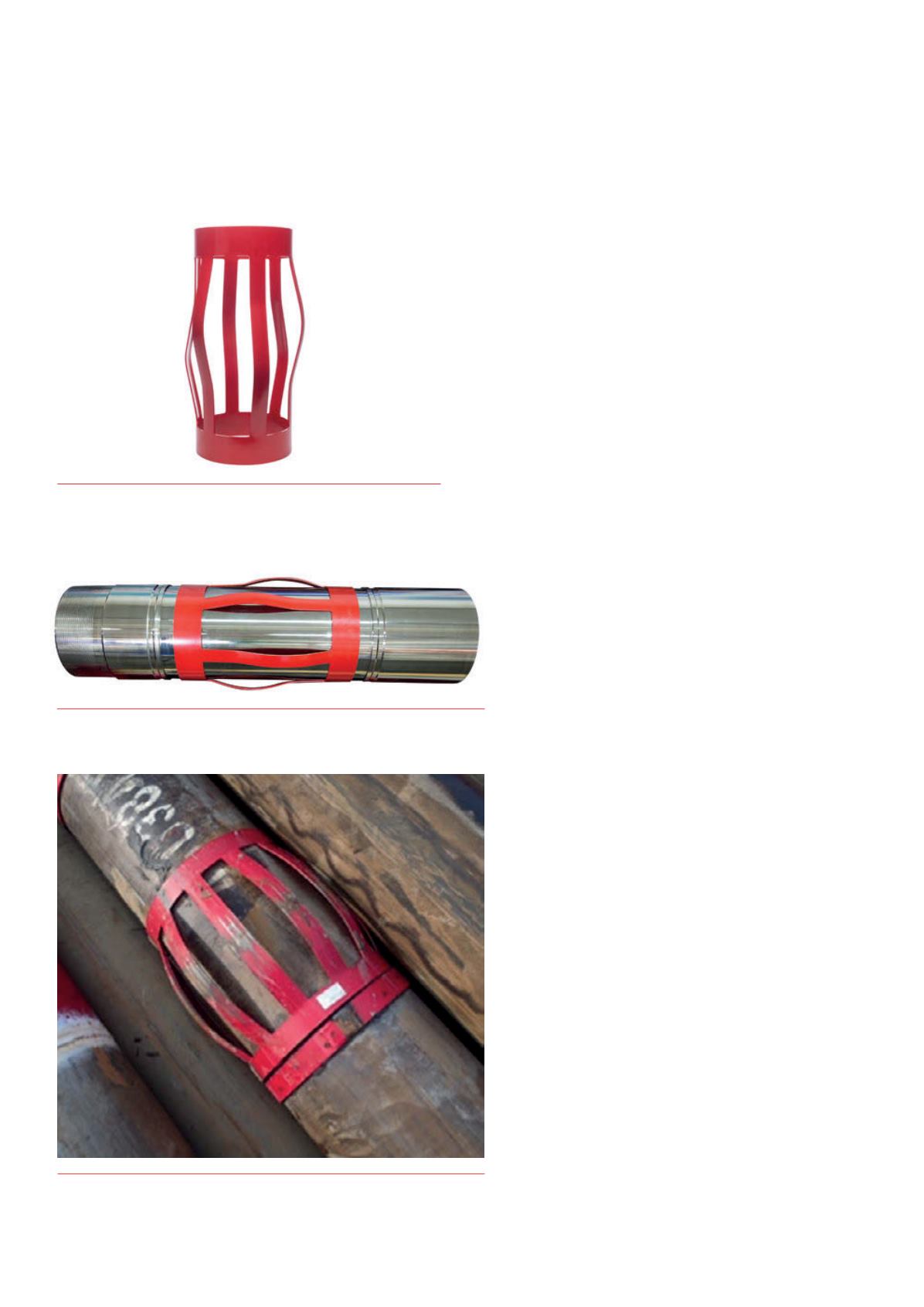
Figure 1.
CentekUROS-CT is a close tolerance, offset bowspring
centraliser designed for tight tolerance, under reameddeepwater wells.
Multiple power cables chase throughout the rig structure.
Figure 2.
Centek centraliser sub for ultra-narrowannuluswellborewhere the
centralisermust recess completely into the inter casing subbody.
Figure 3.
S2 centraliser undamagedafter 800 ft fall inNorway.


