30 |
Oilfield Technology
September
2016
the key issues associated with high ECD and recommended industry
practices to properly manage it. The scope of this article is limited
to drilling ECD only, however, casing and liner cementing in ERD
wells also have significant ECD challenges.
ECDfundamentals
What is ECD? It is the combination of hydrostatic pressure exerted
by a column of drilling fluid and annular pressure losses due to
friction caused by the fluid circulation up the annulus. Since drilling
a well is a dynamic process, annular frictional losses will always be
present and affect the bottom hole pressure.
fluid.
TVD g
P
ESD ECD
*
Δ
+ =
Where ESD is equivalent static density, i.e. hydrostatic head of
a drilling fluid at static conditions and ∆P is the aforementioned
annular frictional pressure loss due to dynamic movement of the
fluid.
Why is ECD important? The drilling process is constrained by an
operating window which is defined by formation strength (in this
case
δh
min
– minimum horizontal stress is more relevant) and pore
pressure gradient (for practical considerations it will be the collapse
pressure gradient). It is crucial to consider maximum loads the
wellbore will experience to manage operational and safety risks and
execute drilling operations cost-effectively.
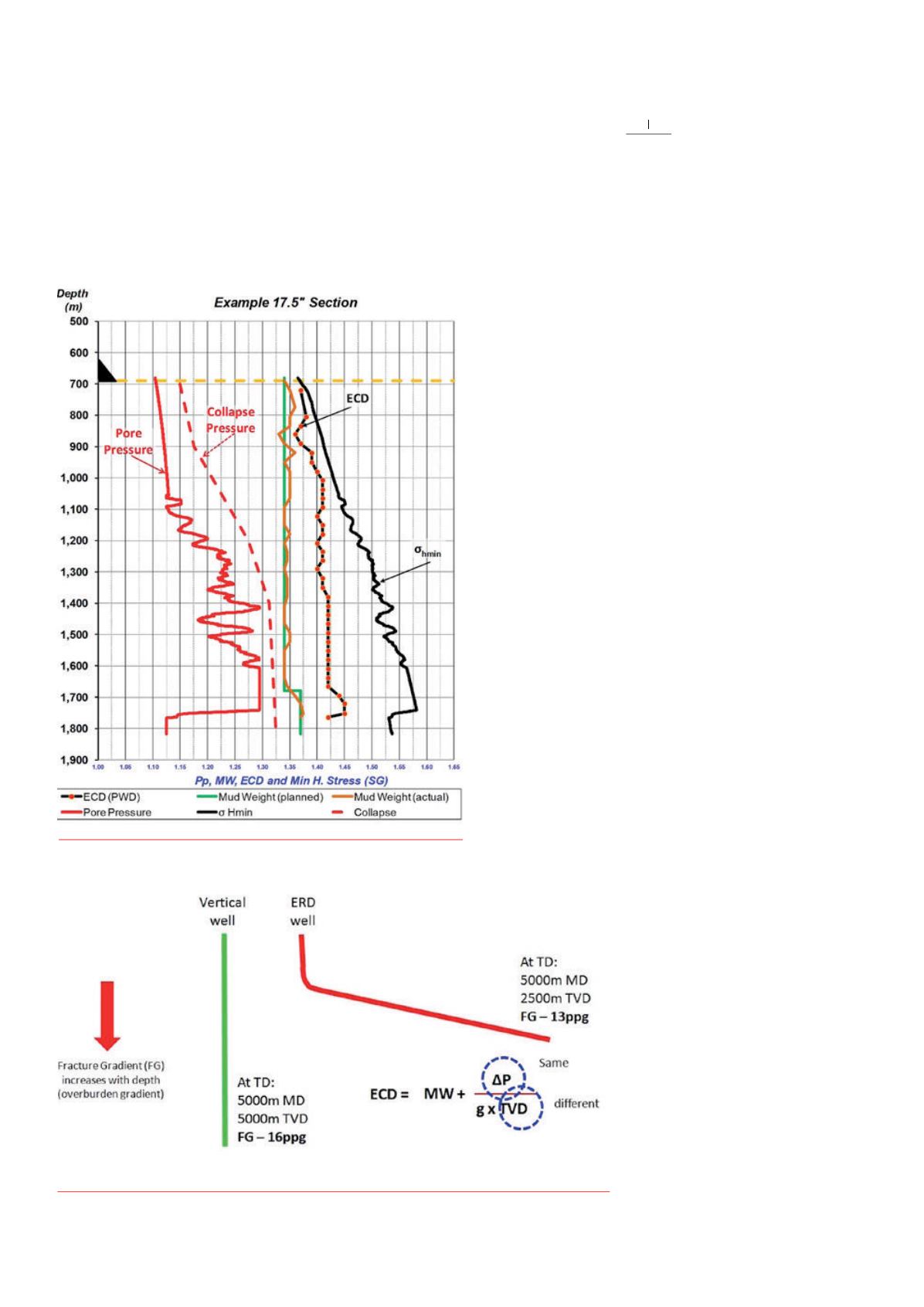
Mud weight windows in shallow, low integrity formations or
deepwater wells have narrow margins. Drilling extended reach
wells further exacerbates the challenges associated with high ECD
(Figure 1).
There are many factors that contribute to annular frictional
pressures/ECD:
Ì
Mud weight and rheology.
Ì
Flow rate.
Ì
Length of the well.
Ì
Pipe rotation.
Ì
Annular cross section.
Ì
Cuttings in the drilling fluid (rate of penetration – ROP).
Ì
Pipe movement (surge and swab effects).
There are many negative consequences of high ECD such as lost
circulation due to exceeding formation strength, wellbore instability
due to cyclic loading of the wellbore (fatigue failure), drilling with
sub-optimal parameters (e.g. low RPM, flow rate and ROP) leading
to hole cleaning issues, pack-offs and potentially stuck pipe.
Additionally, since ECD and surge/swab are directly related, with
higher ECD surge and swab can be severely exacerbated and lead
to well control issues, wellbore instability, formation breakdown
and lost returns. All these issues can result in a well failing to reach
objectives.
It is strongly recommended that expected ECD issues are
solved at the planning stage of a well. This will maximise chances
of success without jeopardising and
sacrificing drilling parameters that are
required to manage other challenges.
ECDinERDwells
ECD management becomes even more
important in highly deviated and
extended reach wells and, in fact, can
become a major show stopper if not
properly addressed at the planning stage.
This is because such wells generally
require higher MWs for wellbore stability
since the drilling fluid must balance
the difference between much higher
stresses than vertical wells, i.e. the delta
between overburden stress
δ
overburden
and
a horizontal stress (
δh
max
or
δh
min
).
Moreover, ERD wells often have to
be executed with shallow true vertical
Figure 1.
Examplemudweight operatingwindow.
Figure 2.
ERD versus vertical well ECD.


