36 |
Oilfield Technology
September 2016
and completions operations thereby reducing risk and increasing
efficiency.
Asignal for change
Traditional data telemetry platforms, such as mud pulse, wired
drill pipe (WDP) or electromagnetic (EM) systems, are subject to
significant limitations. These include operating restrictions such
as the need for fluid and flow, relatively low bandwidth in terms of
EM and mud pulse platforms and/or complicated installation with
associated high implementation costs of WDP, all of which lead to
increased barriers to deployment.
WDP may represent the most comprehensive platform for
information acquisition via telemetry because of the high levels
of data that can be achieved. However, this process requires a
dedicated string through wired components and its integration
can be costly, lengthy and operationally complex.
EM platforms often support a niche land-based market,
as their data acquisition rate is relatively low, but they are
formation-dependent and difficult to implement in an offshore
environment.
Mud pulse telemetry platforms are currently the most common
method of downhole data acquisition, but are only employed during
drilling operations and are therefore not an option for the completion
installation process. They work by restricting fluid flow to send
pressure pulses up through the fluid to the surface. However, they
deliver a relatively low data rate, rely on fluid flow, are depth limited
and, critically, create a constriction in the bore of the drill pipe.
Real time downhole data is in general restricted only to
on-bottom drilling through mud
pulse telemetry: this is less than
20% of all well construction
operations and does not include
tripping or connections. XACT’s
telemetry network now opens
this process to approximately
85% of all rig operations –
essentially anytime that drill
pipe or workstrings are in the
hole.
Previous technological
limitations have meant that
operators have traditionally
had to accept that there are
often substantial differences
between their surface
measurements and models,
and what is actually occurring
downhole in the casing,
cementing and completions
environment. This has led to,
and continues to lead to the
potential for non-productive
time and costly delays.
Research from major
global operators obtained
by XACT suggests that the
practice of completing wells
with limited downhole data
in real time has encountered
consistent challenges related
to understanding downhole
conditions during critical
operations. Industry subject
matter experts have repeatedly
suggested that up to 50% of all
offshore wells have sub-optimal
completions, while 20% result
in material non-productive
time due to a lack of downhole
visibility, with an average
remediation rate of 2 - 3 weeks
per failure – assuming the well
is recoverable.
Improved real time
downhole visibility, which has
significantly benefitted the
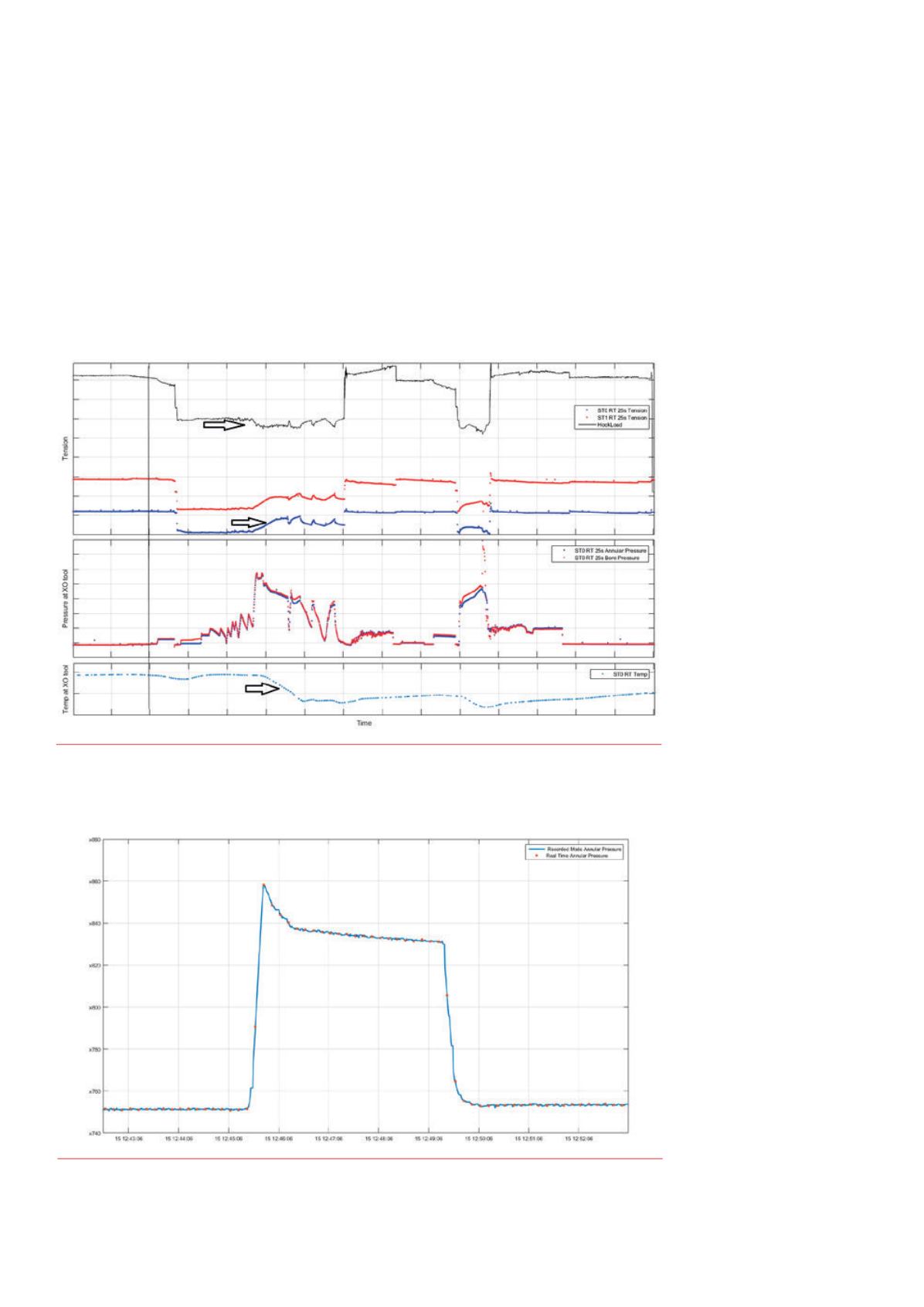
Figure 1.
Real time results transmittedduring the completion installationprocess. The arrows indicatewhen
cooler fluidswere pumpeddown the string. The bottom light blue curve is the temperature downhole at the
crossover tool. As the temperature cools there is a significant change in the downholeweight on the packer
indicatedby the dark blue curve, however the surface hookload (shown inblack) does not react to the same degree.
Figure 2.
Real time results transmitted frombelow the open hole packer during the riserless formation integrity
test. The real time results are overlain on the recordedmode results showing the validity of themeasurement for
use in these environments.


