42 |
Oilfield Technology
September 2016
Pipe rotation or reciprocation before and during cementing
helps break up gelled, stationary pockets of drilling fluid
and loosens cuttings trapped in the gelled drilling fluid. Pipe
movement allows high displacement efficiency at lower pump
rates because it helps to keep the drilling fluid flowing. The
Centek S2 and UROS centralisers are designed to ensure an
increased annular flow by area, reducing annular friction
pressure to allow higher flow rates, and also provide reduced
surge to the formation while running casing.
Casestudies
A Norwegian customer in the Ekofisk field needed a centraliser
system for a particular close tolerance operation in a
deepwater well with a total vertical depth of 9778 ft RKB and
a measured depth of 16 614 ft RKB (rotary kelly bushing is a
reference point for measuring well depth).
The centralisers were required to provide reduced insertion
and low running forces in the restricted section of the well
which was assessed at the outset using the company’s Latload
modelling software. In addition correct standoff and a high
axial stop collar load capability was needed to meet close
tolerance requirements – and all this within a tight budget. For
this particular well the drill team needed to run a 17 in. liner
through a wear bushing restriction with an internal diameter of
17.75 in. to 10 810 ft total vertical depth (TVD). Close tolerance
applications of this type usually require an expensive centraliser
sub.
Centek and Halliburton recommended using the UROS-CT
centraliser and a new type of stop collar from Ace Oil Tools. The
UROS-CT close tolerance centraliser is specifically designed
for use in tight annulus applications, where the margins
between pore pressure and the fracture gradient are narrow. In
deepwater operations the UROS-CT can compress virtually flat
to allow travel through a series of tight casing strings but once
in the open hole it is still capable of expanding to the designed
hole size.
In this instance, the UROS-CT was used with the
Ace Ratchet Collar because it offers high axial load capability
along with a slim design. The combination of the UROS-CT
centraliser and ratchet collar met the customer’s requirements
and the 17 in. liner passed safely through the tight restriction
without problems.
In Norway, Det Norske lost a 24 joint casing downhole with
30 Centek S2 centralisers on it. The string fell over 800 ft and
had to be fished out of the hole. When the string was pulled out
only one centraliser was damaged. The remainder were used
again successfully to get the string to bottom without further
delays.
In another well in the Norwegian Starfish field, the operator
needed to run a 7 in. 32 ft liner into an 8½ in. open hole, first
passing through the 8.535 in. internal diameter restriction
of a 9 ⅝ in. - 53.5 ft casing. Total depth (TD) was 11 811 ft.
The liner and centraliser also had to negotiate a whipstock
window. Rotation helps get casing down, and the liner was
rotated in the open hole on the way in. This was a difficult
well and eventually the liner had to be pulled, due to hole
conditions, 130 ft short of TD. Removal was not easy and
to extract it, the liner had to be rotated in the cased hole
and open hole on the way up for approximately 12 hours
at 20 rpm. Rotating pipe for this length of time with
conventional hinged bow spring centralisers often results
in damaged or broken centralisers with the danger of
debris lost down hole and the need for another fishing trip.
The UROS centralisers came out undamaged and with no
breakages.
Summary
The primary purpose of a centraliser is to help get casing
to the desired position in the well, and the objective is to
keep the pipe off the bore wall at all times. Centralisers in
deepwater wells must absorb severe lateral loads caused
by inclination and azimuth well changes, so robust and
high restoring force centralisers are preferable as they
provide flexibility. Centralisers should also be strong
enough so as not to break or be damaged should casing
have to be pulled out of the well.
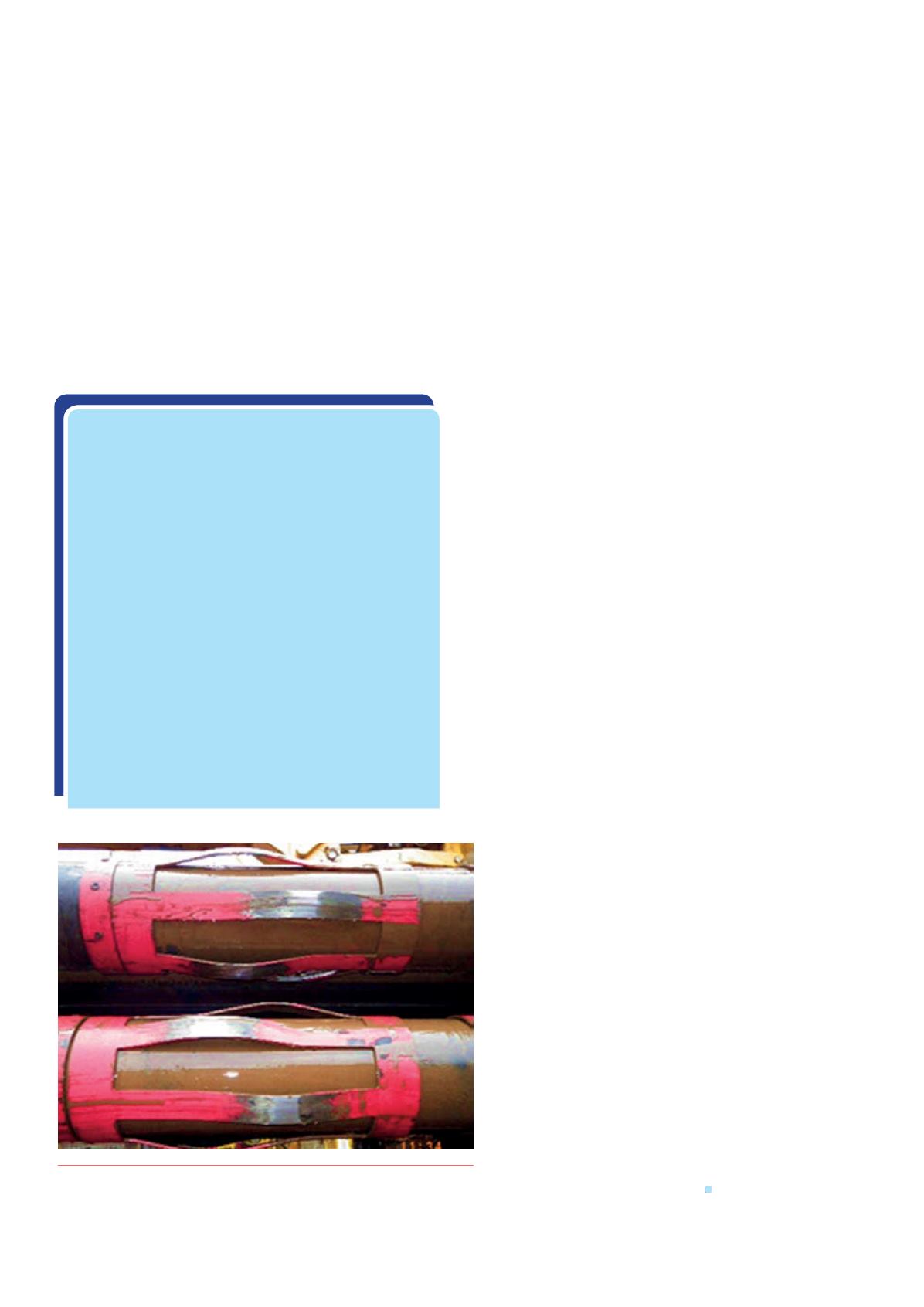
Figure 4.
UROS centralisers undamagedwhen liner was pulledafter 12 hours
rotationdown hole in the Starfish field.
The UROS-CT centraliser is designed and manufactured
with minimal clearance to the casing, and with a precisely
formed cross bow curvature so that there are no ‘knife
edges’ (common among standard bow spring centralisers)
which reduces the risk of subsea well head damage.
Crucially, during operation the bows can compress
virtually flat to the casing body and so pass through the
tightest of restrictions protecting the bows from damage.
Centek’s centraliser sub is designed to be run as part
of a tight tolerance casing string in deepwater, ultra-
narrow annulus applications. It uses the under reamed
offset close tolerance (UROS-CT) centraliser design
to give optimum restoring performance with minimal
starting and running forces through the very tightest
of restrictions. For deepwater, ultra-narrow annulus
applications it is an alternative to standard subs that have
higher initial insertion forces due to bow design. The sub
body, manufactured to API 5CT requirements, will meet or
exceed burst, collapse and tensile ratings and is threaded
to meet requirements for the casing string.


