58 |
Oilfield Technology
September 2016
bandwidth for
Stril Server
was required by client engineers on a
project at the Westernmost Rough offshore wind farm on the UK’s
east coast.
Marlink increased the available bandwidth on board to 8 Mbps
downlink and 4 Mbps uplink. This enabled the client to operate its
own dedicated network aboard
Stril Server
, facilitating updating
and management of documentation using tablet computers.
Engineers and managers could read and edit documents on their
tablets, enabling them to work more effectively through greater
collaboration and convenience. A specially installed on board server
would synchronise all data with the client’s on board and shore-side
network to ensure all documentation was fully up to date. The
increased bandwidth facilitated the reliable and fast transfer of all
data.
The bandwidth upgrade was deployed using the already
installed above deck equipment that facilitates on-going VSAT
services for the
Stril Server.
In order to enable the increased data
throughput for the duration of the project, the existing iDirect X5
modem was upgraded to a new generation iDirect X7 modem.
High satellite capacity and strong relationships with major
satellite network operators (SNO) meet the needs of customers
in the high-end offshore and specialist vessel market, looking to
increase bandwidth on request of their clients or for short-term
projects. Temporarily increasing bandwidth can be a complex task,
but the inherent flexibility in the VSAT services already provided
to
Stril Server
, combined with close co-operation with the SNO,
ensured that Simon Møkster could deliver the bandwidth that its
client needed for this specific project.
As offshore vessel technical projects evolve to require more
high-end connectivity, flexibility in Internet service is vital. A
shipping owner need not invest in very high bandwidth all year
round, but the facility to increase on short notice for defined
periods allows special projects to run smoother. Simon Møkster
already operates an advanced communications network across
its fleet, classing each of its vessels as a remote office in its own
right. So applying forward-thinking approaches such as short-term
bandwidth boosts on request is a natural step for this modern
offshore vessel operator.
A significant temporary bandwidth upgrade for the
Atlantic Explorer
, a Petroleum Geo Services (PGS) owned
seismic survey vessel has already been provided. The project
delivered a 12 Mbps dedicated return link during a four week
North Sea survey project, enabling seamless transfer of
survey data to shore.
Thenext step
However, that was history. The latest development for
Simon Møkster’s fleet of mostly North Sea based vessels
is the integration of Tampnet LTE (long-term evolution)
services along with the satellite communication systems on
board. Many clients have requested this capability based on
low latency and augmented coverage of the LTE link.
As of June this year, the company has had
Marlink-provided Tampnet North Sea LTE in service across
its entire fleet of vessels. Tampnet’s LTE services are
enabled by an extensive 2500 km subsea fibre network.
The Tampnet connectivity on the vessels works as part
of a hybrid communication service, which also integrates
high bandwidth VSAT, L-band and terrestrial 3G/4G to
create the most complete and cost-effective multi-band
communication system of any fleet in the world.
The integration of Tampnet North Sea LTE service
supports users in the North Sea, enabling them to utilise the
new connectivity for real time applications that appreciate
lower latency links, i.e. video-conferencing or instant
messaging. In addition to low-latency, Tampnet’s technology
is proven to function in adverse weather conditions.
Though these services have been available in the
North Sea since late 2013, the current user-base consists
primarily of FPSOs, drilling rigs and vessels with specific
requirements. Simon Møkster is the first vessel operator
to leverage the offshore mobile service on a fleet-wide
basis, which was made possible because of the partnership
established between Tampnet and Marlink in May 2015. With
access to Tampnet North Sea LTE, Marlink can fully realise
its multi-band service approach, offering an extra layer of
flexibility and cost-effectiveness for users in the North Sea.
Going forward, the company expects to provide integrated
4G/LTE services from suppliers in other regions as well.
The idea behind multi-band/hybrid services is to
seamlessly combine multiple communication carriers
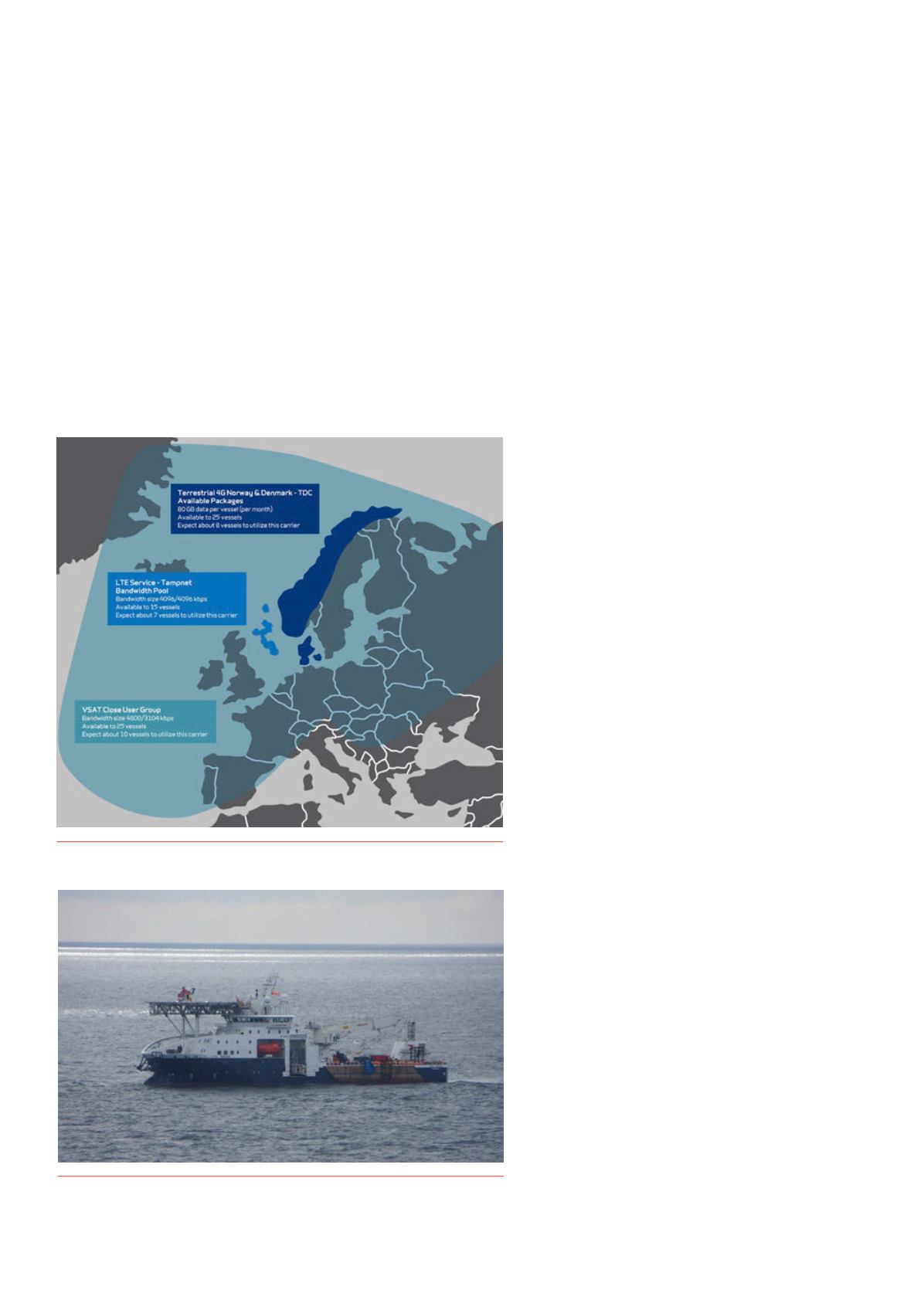
Figure 1.
Tampnet LTENorth Sea coveragemap.
Figure 2.
SimonMøkster’s fleet ismostly active in theNorth Sea, so the combination
of Marlink’s VSATwith Tampnet LTE is anatural solution.


