14 |
Oilfield Technology
September 2016
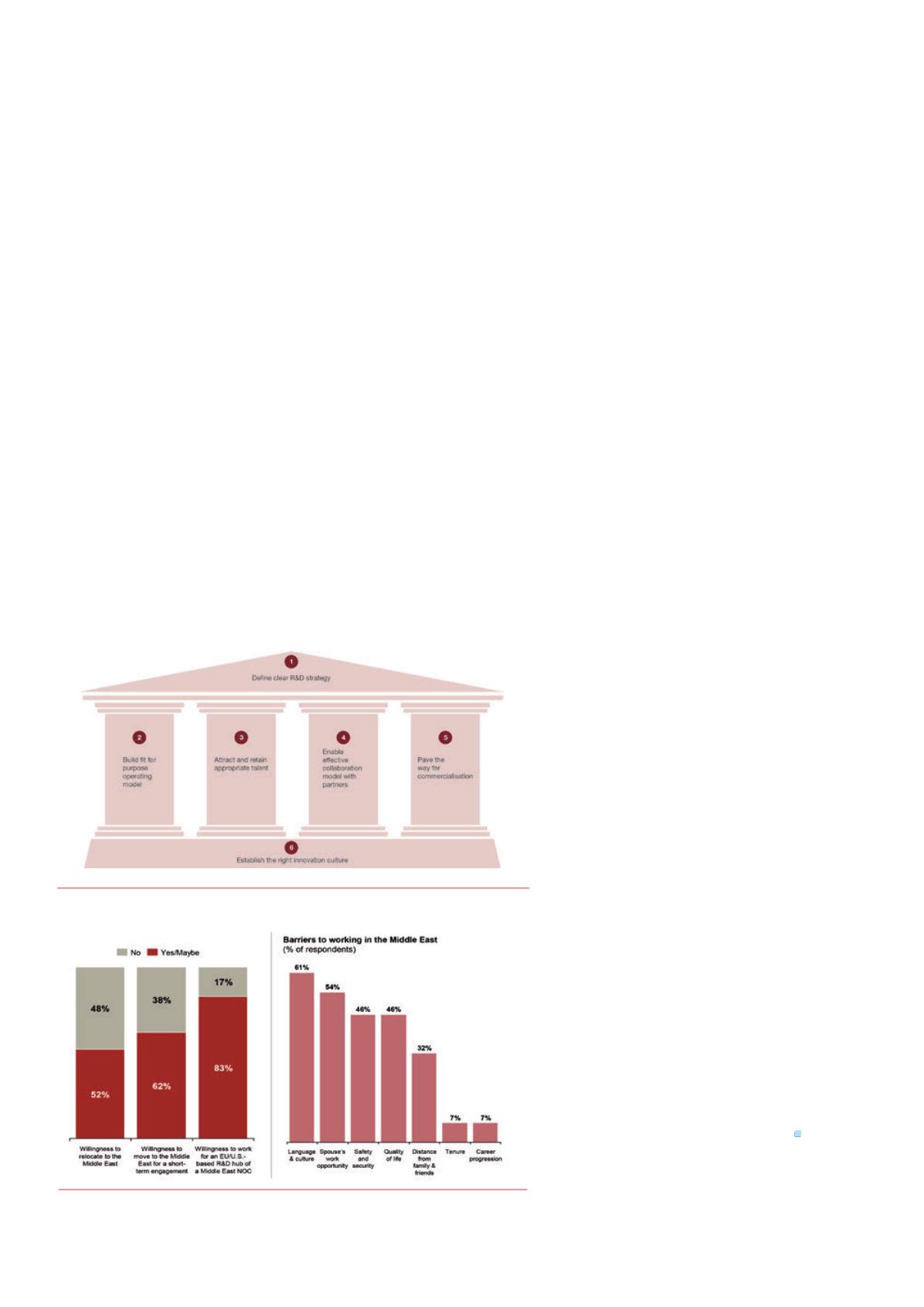
Figure 3.
Framework for buildingabest-in-class R&D setup.
The governance framework should ensure the effective participation all
those directly involved in R&D: the consumers of R&D in theNOC, the
broader internal R&D community, and external experts (whether local
or international). Such amix of views is vital to prevent R&Dblind spots,
facilitate access to research and academic networks, and improve portfolio
assurance. Clarifying processes and decision rights is vital to prevent
duplication of effort and overlapping roles and responsibilities.
Attractandretainappropriatetalent
An R&D strategy is fed by the appropriate talent, which can be difficult
to recruit and retain in theMiddle East. Indeed, a cardinal risk that NOCs
ought to avoid at any cost is to build research centres and later realise that
they cannot populate these facilitieswith the researcher capabilities that
enable themtowork. A recent Strategy&R&D talentmobility survey found
that qualified individuals prefer towork for NOCs either on a short-term
basis in theMiddle East, or near to EUandUS research hubs run by
NOCs (Figure 4). Various language, personal, and security considerations
dissuade people frommoving to the region. In response, Middle East NOCs
should improve their talent value proposition. They need to domore
than offer attractive compensation and benefits. In addition, they should
incorporate other considerations such as a flexiblework environment
and improved professional and educational support to families. A
complementarymethod is to look for researcherswithMiddle Eastern
connections, whomay bemore open tomoving to the region. NOCs can
also consider expanding their R&D footprint in the EUandUS.
Enableaneffectivecollaborationmodelwith
partners
An effective collaborationmodel with the right external partners is
critical to reaching overall R&D objectives. To achieve this, NOCs need to
align up front on whether the collaboration’s purpose is solely to address
technical challenges or also to develop in-house capabilities. NOCs can
meet their research and capability requirements by choosing partners
with which they have a strong capability fit and decide on the right
collaborationmodel (e.g., strategic collaboration versus project-based
collaboration). Whilemaking these decisions, NOCs need to bear inmind
that themotivations for their research partners – be they universities,
service providers, or other oil and gas companies – will vary. They need
to understand thesemotivations so that there is agreement on common
goals and interests. For example, service providers often want to pilot
new technologies and seize future sales opportunities. Universities
are often looking for financial support for research and educational
activities, along with citations and publications.
Pavetheway for commercialisation
Themajor challenge for NOCs is to translate ideas into significant
economic outputs such as licenses, jobs, products, and services.
The leaders of NOCs need to design a portfolio commercialisation
framework and have clear views on issues such as intellectual property
(IP) protection, patents, andmonetisation opportunities. Turning ideas
into sales also requires an environment in which researchers have the
incentives and the technical support (e.g., prototyping, engineering,
incubators, etc.) that can lead to effective commercialisation. NOCs also
need to develop customised processes across the commercialisation
value chain to push ideas tomarket. These specially designed processes
will assist with technology assessment, IP protection, marketing, and
relevant commercialisation channels such as licensing and startup
formation.
Establishtheright innovationculture
Fostering the right innovation culture requires making sure that NOCs’
innovation goals, workplace culture and behaviours are consistent
with their overall R&D strategies. An innovation culture
will animate the other elements of the framework and
help NOCs fully realise commercial value from their R&D
activities. The problem for NOCs is that they often have
workplace cultures that inhibit innovation. There is little
encouragement and reward for staff to be innovative,
and there is often insufficient cross-function/business
collaboration to solve technical challenges. NOCs can
transform this risk-averse culture. They can promote
positive behaviours and change inside the organisation.
This requires leadership commitment, encouraging the
workforce to take pride in its work, empathy with internal
and external customers, cultural traits that energise
innovative behaviours, and collaboration inside the
company as opposed to operating and thinking in silos.
Conclusion
Middle East NOCs are ambitious. They want to become
technology innovators and solve their country-specific
technical challenges themselves. If they can develop the
right capabilities, they can build a fully functional R&D
setup. This will position them to deal more effectively
with the greatest challenges to their long-termbusiness
strategy. It will provide global recognition and influence
research trends in the oil and gas industry. Most
importantly, it will secure the place of Middle East NOCs in
the global oil and gas innovation ecosystem.
Note
The authors aremembers of the energy, chemicals, and
utilities practice at Strategy& (Part of the PwC network).
Figure 4.
Key findings fromStrategy&’s R&D talentmobility survey.


