6 |
Oilfield Technology
September
2016
World news
September 2016
Diary dates
To read
more
about these articles
and for more event listings go to:
Web news
highlights
Ì
US onshore oil production has stopped
declining; growth is coming from the
Permian Basin
Ì
Statoil prepares major exploration
campaign in Barents Sea
Ì
Fluenta to supply flare gas meters
Ì
API: US leads in energy production and
emissions reduction
Global Maritime completes
Njord A disconnection
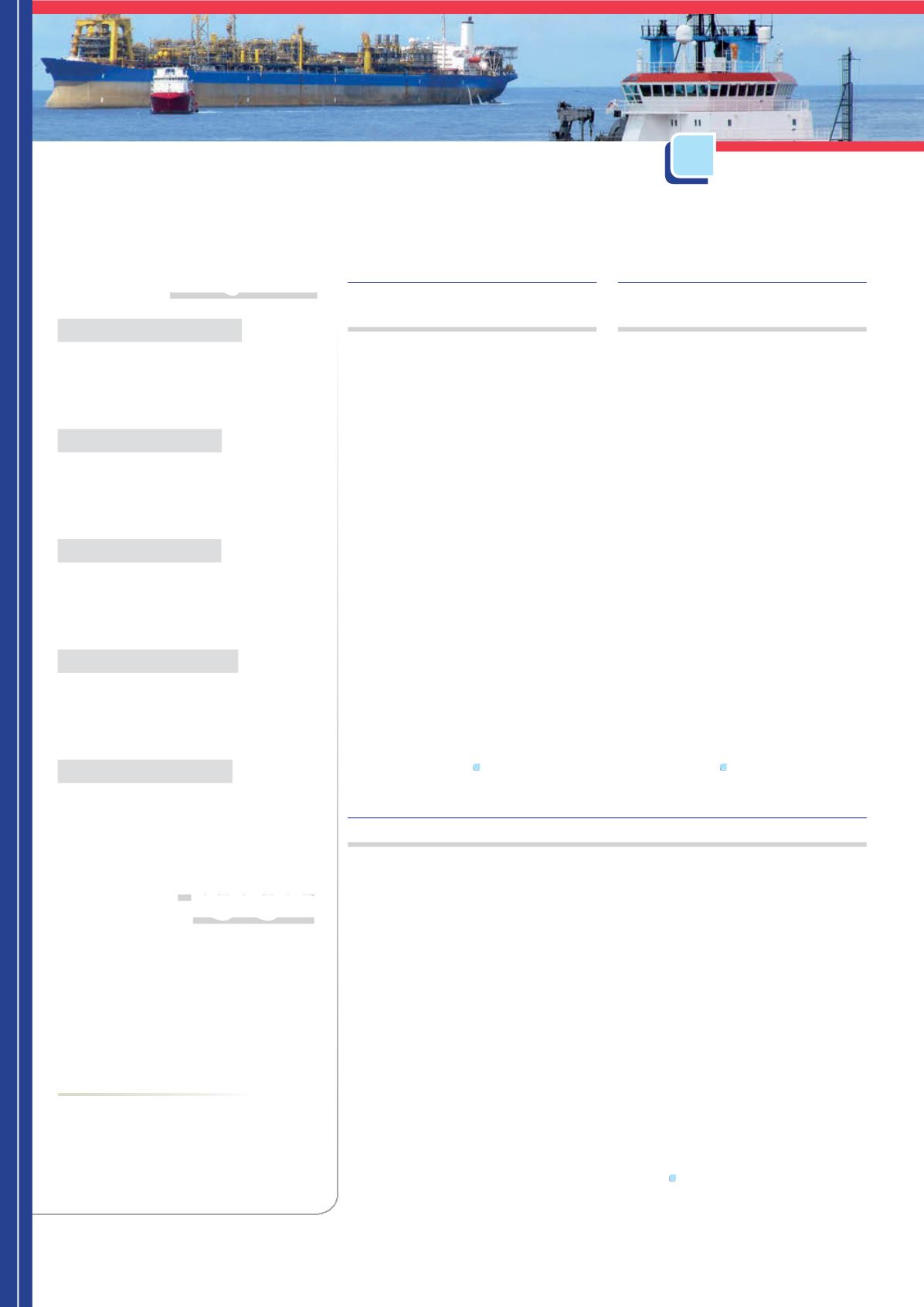
Global Maritime Consultancy & Engineering
has successfully led the disconnection
and towing operations of the Njord A
semisubmersible floating production
platform from the Njord field. The Njord A
platform arrived safely in Klosterfjorden
on the 23 August, where a handover to
Kværner was achieved.
The 346 nautical-mile journey was
carried out by Global Maritime, on behalf
of the operator Statoil. The news follows
the successful towing of the oil storage
and offloading vessel Njord B by Global
Maritime to Sterkoder, Kristiansund earlier
this summer.
Global Maritime’s responsibilities
included the disconnection of 12 mooring
lines, the recovery of one complete mooring
line (excluding the suction anchor) for
onshore inspection and the towing-in of the
Njord A platform to Klosterfjorden outside
the Stord yard. Statoil coordinated the
decommissioning activities including the
disconnection of risers and the temporary
plugging of wells.
SeaOwl acquires Osgas
Solutions
SeaOwl has announced the acquisition
of Osgas Solutions. This acquisition will
allow SeaOwl Group to pursue its growth
and contribute to the consolidation of the
industry on an international level with an
integrated services offer.
With this new acquisition, SeaOwl not
only increases its market share within the field
of oil and gas technical assistance but also
expands its expertise to new segments within
the energy sector and further strengthens
SeaOwl’s ability to bring innovative services to
customers and geographies.
Complementarity is a key aspect of this
acquisition. It will allow SeaOwl to cover
the key growing geographic areas across
the world and to extend its activities to
all the critical expertise and core markets
segments in the industry. The new group
thus formed will operate on every oil and
gas segment and will keep on developing
its activity by offering integrated services to
its clients - including global maintenance
contract (GMC) offers - while preserving its
proximity with clients.
26 - 28 September, 2016
SPE ATCE
Dubai, UAE
E:
24 - 26 October, 2016
Arctic Technology Conference
St. John’s, Canada
E:
24 - 27 October, 2016
Rio Oil & Gas
Rio De Janeiro, Brazil
E:
07 - 10 November, 2016
ADIPEC
Abu Dhabi, UAE
E:
15 - 17 November, 2016
PETEX 2016
London, UK
E:
Fjords Processing wins contract with Shell
Fjords Processing has won a significant contract with Shell UK.
Within the DECC implementation programme, Norwegian-based multinational
Fjords Processing will deliver risk based approach (RBA) environmental impact studies for
produced water discharges from the Nelson, Gannet, Shearwater, Leman, Brent C and Pierce
fields this year, as well as the Lomond and Everest streams in coming years.
The company specialises in fluid stream separation, oil and gas processing, and water
treatment solutions.
In addition to carrying out the ecotoxicology testing of discharges from production
operations, the Shell project includes provision of sampling guidance and dispatch kits;
as well as computer modelling of post-discharge environmental implications. Results are
compiled into a detailed report for each individual discharge that is then logged with the
regulators to ensure Shell complies with new guidance brought into force by the Department
of Energy and Climate Change in 2014.
The ecotoxicology tests and computer modelling is carried out at Fjords’ renowned
research, development and testing base at Flotta in Orkney.
Using the ‘dose related risk and effect assessment model’ (DREAM) programme, scientists
can mimic site specific conditions, including weather and tidal data, to characterise the
environmental risk of offshore discharges. This includes produced water, MEG (mono ethylene
glycol) and mud discharges and decommissioning sludge.


