12 |
Oilfield Technology
September 2016
At a national level, NOCs are establishing dedicated oil and gas R&D
facilities. For instance, the AbuDhabi National Oil Company (ADNOC) is in
the final stages of inaugurating its Petroleum Institute research centre in
AbuDhabi. They are also playing amore significant role in the integration
of the oil and gas innovation ecosystem into that of their home economies.
Indeed, NOCs are creating effective linkages between their own in-house
R&D centres and other research and academic institutions, service
companies, and external universities. These linkagesmake the innovation
ecosystemwork, thereby promoting theNOCs’ innovation agenda and
meeting their business needs. Moreover, NOCs are taking on amore
active role in establishing technology parks to create forums that bring
partners and academic institutions closer to theNOCs’ operation sites.
Saudi Aramco for example is actively shaping the vision of the Dhahran
Techno-Valley to attractmajor oil and gas players.
At an international level, NOCs are also expanding their investments
in physical oil and gas R&D facilities. Saudi Aramco recently opened a
research centre inDetroit, its eighth satellite research facility and its third in
theUS. Additionally, NOCs are strengthening their portfolio of relationships
by establishing large-scale strategic collaboration agreementswith
external parties. By doing so, they are delivering specific R&Dprojects,
advancing their own capability development and increasingly
participating in shaping the global discussion on oil and gas R&D and
innovation. Notable examples areQatar Petroleum’s collaborationwith
Imperial College London in theQatar Carbonate and Carbon Storage
Research Centre and Saudi Aramco’s Aramco Fuel Research Center created
in collaborationwith France’s IFP Energies Nouvelles (IFPEN).
Risingtothechallenge
AlthoughNOCs have laid the foundations, building innovation capabilities
requires addressing several region-specific challenges. These include the
limited nature of local innovation ecosystems in the oil and gas sector,
insufficient governmental support for R&D, the scarcity of research
talent, weak links between academia and industry, and the predominant
workplace culture of sourcing technologies fromexternal suppliers rather
than developing in-house solutions. Middle East NOCs can overcome these
problems by using a framework that proceeds fromdefining a strategy to
establishing the appropriate innovation culture (Figure 3). Along theway,
it is crucial for themto understand that building R&D capabilities is not
about creating another cost centre. Rather, R&D capabilities
offermany opportunities to generate returns in the long term
and, very often, in the short term.
DefineaclearR&Dstrategy
NOCsmust start by defining a clear R&D strategy that is
tailored to their business needs. The strategywill therefore
depend on eachNOC’s upstreamand downstream
specificities and aspirations. For instance, upstream
R&D tends to focus on country-specific challengeswhile
downstreamR&Doften tackles challenges common to
several NOCs and international oil companies. Bearing
those specificities inmind, NOCswill require clarity on their
R&Dmandate, their R&D focus, and their ambitions for R&D
capabilities. NOCs need to agree onwhether the company’s
mandate is to promote R&D efforts at a company level or
at a broader country level. Once this has been decided, it is
essential to identify and prioritise areas that are critical for the
success of long-termbusiness strategies andNOCs’ agreed
national mandates. After that, NOCs should clearly outline
their capability ambitions. Thismeans specifying inwhich
areas theywill simply adopt the best available technologies
fromexternal suppliers and inwhich areas theywill develop
in-house capabilities and solutions. The R&D strategy then
needs to be stress-tested to ensure that it can survivemarket
volatility and uncertainties. Furthermore, and as part of
their strategy definition efforts, NOCs need a set of portfolio
management tools, systems, and processes that will lead
to transparency in the R&Dportfolio and propermonitoring
of R&D activities. R&Dportfoliosmust address current and
future business and technology requirements. In addition,
R&Dportfolios should possess an optimal risk profilewith a
mix of lower risk, often short-term, projects and higher-risk,
often longer-term, projects.
Buildafit-for-purposeoperatingmodel
NOCsmust define the right organisational model, governance
framework, processes and decision rights if they are to build
a fit-for-purpose R&Doperatingmodel. To achieve this, the
R&D functionmust be positioned so that it fosters strong
linkages between the development and deployment of new
technologies, enhances cross-disciplinary collaboration, and
ensures seniormanagement ownership of the R&D agenda.
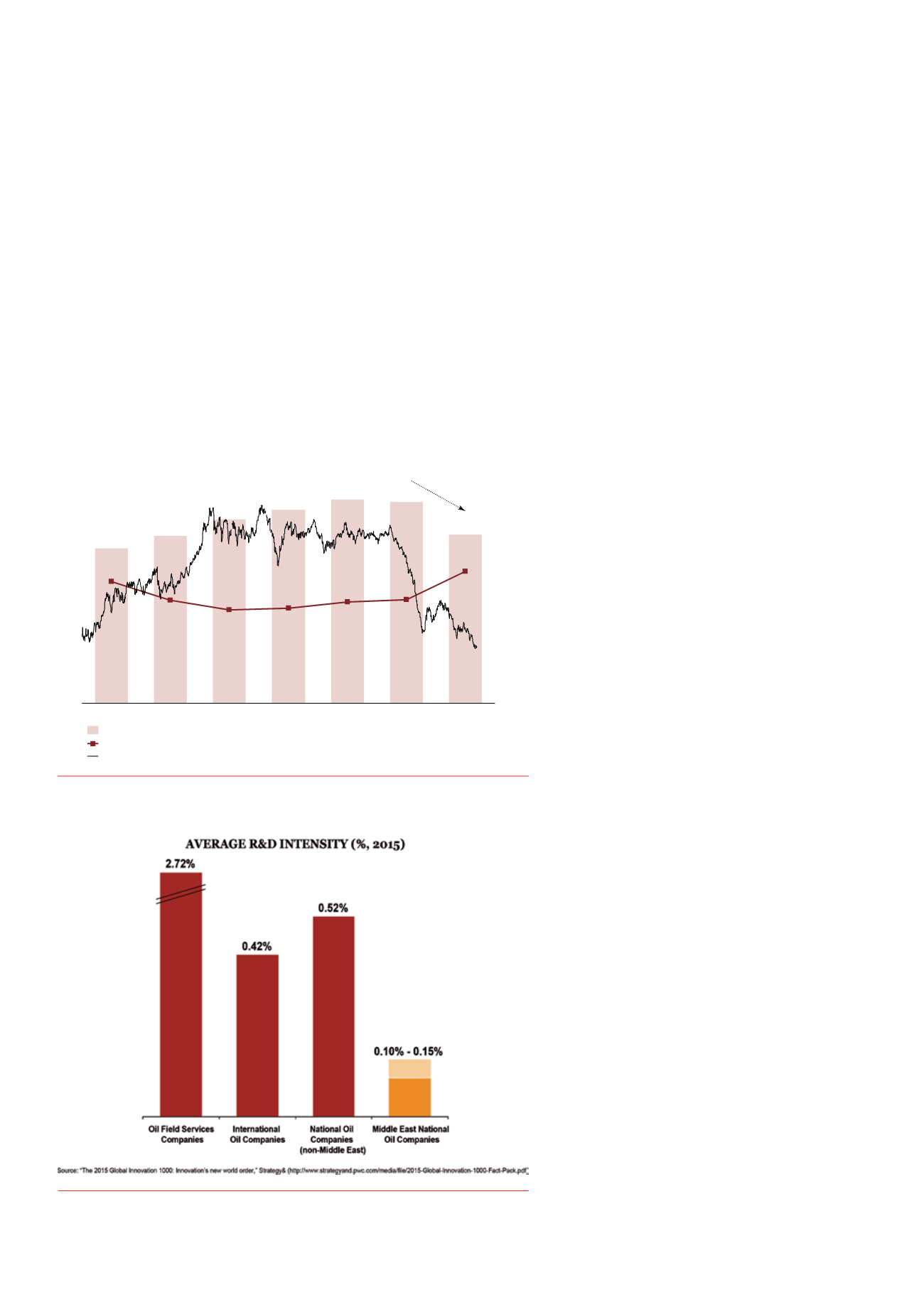
Figure 2.
Middle East NOCs lagbehind the rest of the industry in research intensity.
Figure 1.
Oil andgas R&D intensity is rising, despite broader falls inR&D spending.
11.4
13.6
13.7
13.0
12.4
11.3
10.4
1.0
0.9
0.8
0.7
0.6
0.5
0.4
0.3
0.2
0.1
0.0
2015
0.55%
2014
0.44%
2013
0.43%
2012
-16%
0.40%
2011
0.39%
2010
0.43%
2009
0.51%
Overall R&D Intensity (%)
Overall R&D spending (US$ billion)
Brent Oil Price (US$)
0
10
20
30
40
50
60
70
80
90
100
110
120
130
US$/barrel
R&D
intensity (%)
Exhibit 1
Oil and gas R&D intensity is rising, despite broader falls in R&D spending
Note: R&D intensity is the ratio of R&D spending to revenues
Source: “The 2015 Global Innovation 1000: Innovation's new world order,” Strategy&
(
, Strategy& analysis


