18 |
Oilfield Technology
September 2016
length and orientation. While the underlying details of these failure
processes may be complex, the far-field signals that are observed
frommultiple azimuths are inverted for a simplified model of
the failure process that is the moment tensor. Specifically using
a multi-array, multi-well distribution of microseismic sensors,
high-quality microseismic data can be uniquely processed using
seismic moment sensor inversion (SMTI) to describe type of failure
(e.g. tensile, shear or shear-tensile), fracture azimuth and dip and the
relative dimensions of the failure surface. SMTI takes microseismic
waveforms, back-projects this information to the seismic hypocentre
(focal sphere) to construct the radiation patterns of the P, SV, and
SH wavefields; and then, from the radiation patterns, inverts for
the failure mechanism. The failure mechanism is represented by
the moment tensor. Because of the symmetries in this system,
the moment tensor is described by six independent components.
Ambiguity in the fracture plane is resolved using information about
the state of stress for the mechanisms.
While inferring the stress conditions from SMTI in general involves
a joint inversion for possible fracture planes and the stress, the strain
conditions are more easily ascertained. The seismic moment tensor
is proportional to deformation (strain rate) and as such each event
yields a point measure of strain. As such, deformation state analysis
can be used to infer the strain field in the reservoir, using nearest
neighbour clustering over the seismogenic area.
Performing seismic moment tensor inversion on microseismic
events that occur during a stage of a hydraulic fracture shows very
directly how the strain is dynamic throughout the treatment by simple
consideration of the fact that moment tensors are proportional to
deformation. To image the stresses, mechanisms can be clustered
in time and space to invert for the best fitting state of stress within
each cluster. The implications for this dynamic stress field are quite
significant, and demonstrate the value of higher-order analyses of
microseismicity in constraining the stress field during the treatment.
Such information is invaluable to the calibration of geomechanical
models, because the propagation of the hydraulic fracture and
ultimately fluid and proppant flow are controlled by these stresses.
Casestudy: temporal analysisofachangingstrain
field
Microseismic data was analysed from a single stage of a
multi-well zipper frack completion in the Horn River Basin in
Northeast British Columbia. All of the events were monitored
with three long sensor tool strings; two of which comprised 36
levels and one comprised 24 levels. The treatment well in this
example was drilled into the uppermost, Muskwa formation but
events transitioned into the lower Otter Park formation during the
treatment. Using SMTI methods, events exhibited predominantly
mixed-mode shear tensile mechanisms which enabled analysis of the
deformation and stress fields in the volume.
The temporal progression of the strain field through this stage
is illustrated in Figure 1; the variations in the strain field imply a very
dynamic stress field is controlling the progression of the fractures and,
by extension, the fluids and proppant into the reservoir. In particular,
on examination there are several areas where the strains are rotating
throughout the treatment. For example, in the first interval, there
are a few events that have extended the fracture to the NE and the
associated tensional strain field is sub-horizontal in this NE trend.
Subsequently, examination of the events in interval two reveals that
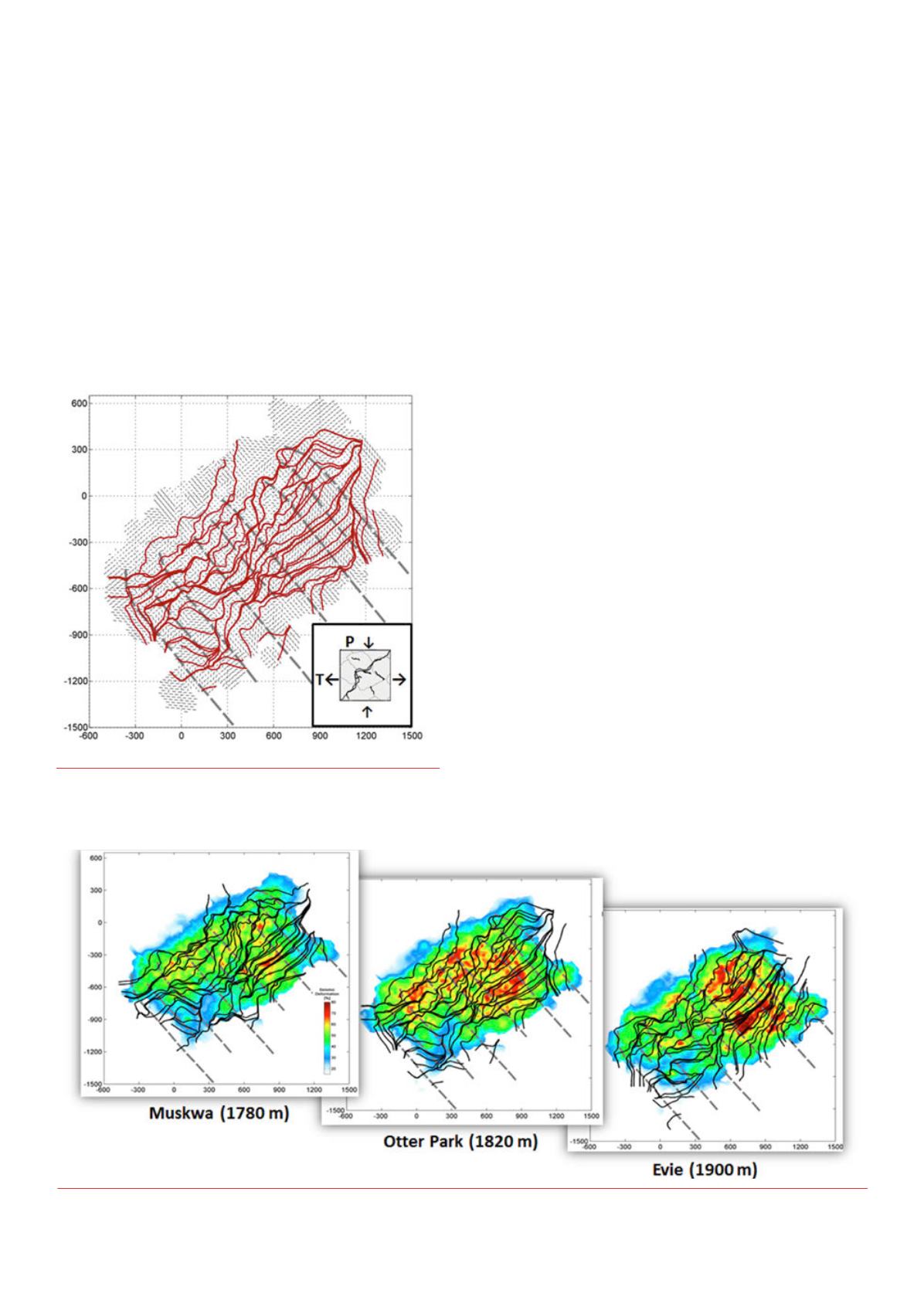
Figure 3.
Streamor flow lines representing the trajectories of particles
ina steady flowunderplayedby orientation vectors of theminimum
principal stress showingboth trendandplunge (vector length).
Figure 4.
Streamlineswith contoured seismic deformation for the three formationswithin theHornRiver Basin.


